
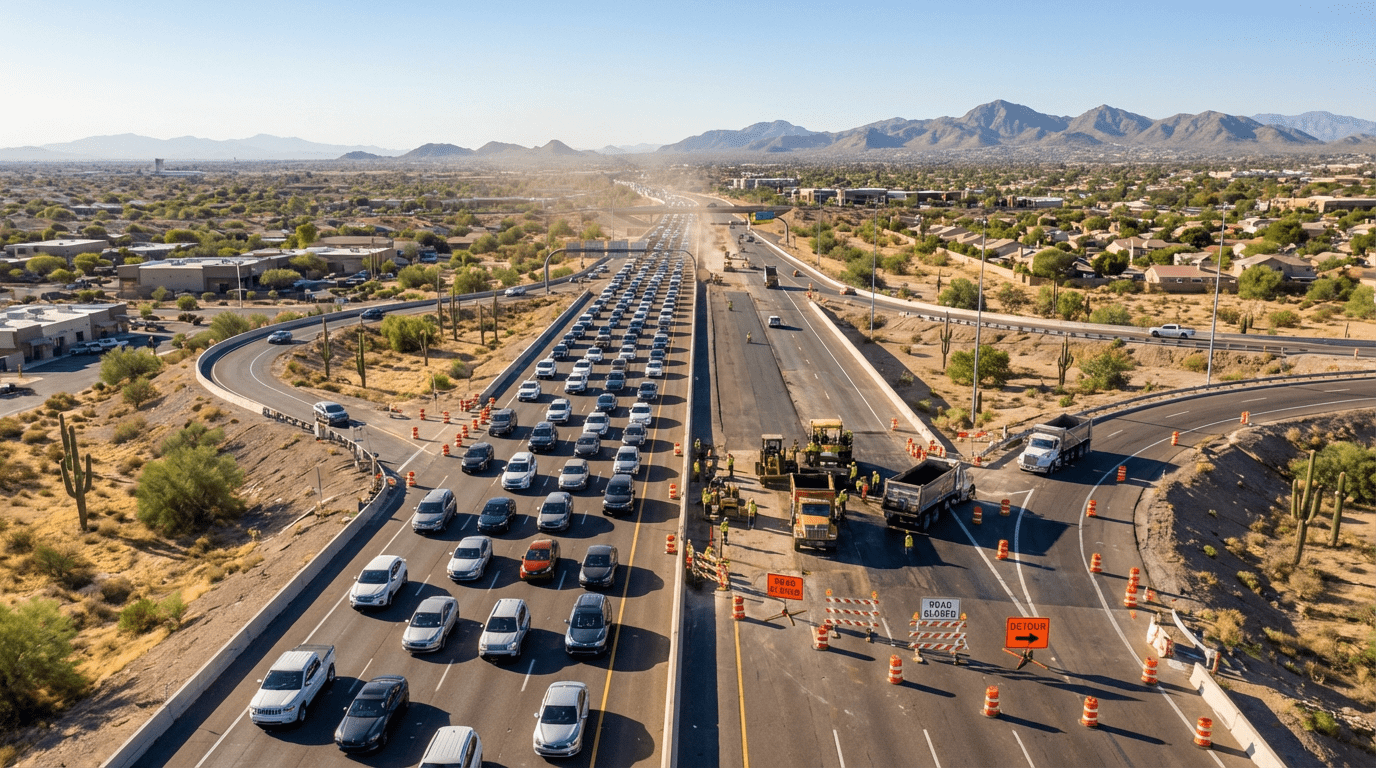
If you’ve driven around the northwest Valley anytime recently, there’s a good chance you’ve muttered a few words under your breath about traffic. Not just regular Phoenix traffic. The kind that sneaks up on you, slows everything to a crawl, and leaves you staring at brake lights wondering what just happened.
For many drivers, that moment came with the Loop 101 Agua Fria ramps closure.
One day the ramps were there. The next, orange signs, cones, detours, and confusion. People were late to work. Parents scrambled to get kids to school. Delivery drivers rerouted on the fly. And local Facebook groups lit up with the same question over and over again:
“Why are the Loop 101 Agua Fria ramps closed?”
Let’s talk about it. Not in stiff press-release language, but the way real people experience it behind the wheel, in the heat, watching the clock tick.
The Loop 101 Agua Fria: A Critical Piece of Valley Traffic
Before diving into closures, it helps to understand why this stretch of road matters so much.
The Loop 101 Agua Fria Freeway isn’t just another highway. It’s a backbone for the northwest Phoenix area, running through places like Glendale, Peoria, and near Surprise. Thousands of commuters rely on it every single day.
Morning rush? Packed. Afternoon school pickups? Busy. Weekends? Still moving.
So when even one ramp shuts down, the ripple effect is immediate.
Now imagine multiple ramps impacted.
That’s exactly why the Loop 101 Agua Fria ramps closure has felt bigger than “just road work” to so many drivers.
What Triggered the Loop 101 Agua Fria Ramps Closure?
This isn’t random. And it’s not just for fun (even though it sometimes feels that way when you’re stuck in traffic).
The closures are part of a broader improvement and maintenance effort. Arizona’s highways take a beating extreme heat, heavy traffic, and time all play a role. Asphalt cracks. Bridges need inspections. Drainage systems need upgrades, especially with monsoon season in mind.
Transportation agencies don’t always get credit for preventing future disasters, but that’s usually what’s happening behind the scenes.
In the case of the Loop 101 Agua Fria ramps closure, the work generally includes:
- Pavement rehabilitation
- Ramp realignment or resurfacing
- Bridge and structural maintenance
- Drainage improvements
- Safety upgrades like signage and barriers
Not glamorous. But necessary.
If you’ve ever hit a pothole hard enough to spill your coffee, you already know why this work can’t be ignored forever.
Which Ramps Are Affected?
This is where frustration often peaks.
Drivers don’t just want to know that ramps are closed they want to know which ones, when, and for how long.
The Loop 101 Agua Fria ramps closure has typically involved on-ramps and off-ramps at key interchanges. These change depending on construction phases, which is why some people feel like the rules change every week.
One morning you’re cruising like normal. Next morning, a detour sign sends you three miles out of the way.
The best source for real-time updates is the Arizona Department of Transportation. Their official updates live on their site and social channels, and they’re usually more accurate than rumor-based posts online.
You can check current closures and detours directly through ADOT’s official site.
It’s not flashy, but it beats guessing.
How Long Will the Loop 101 Agua Fria Ramps Closure Last?
Short answer: longer than anyone wants.
Longer answer: it depends on weather, construction progress, and safety inspections.
Most ramp closures tied to freeway improvement projects are scheduled in phases. Some last a few nights. Others stretch across weeks. Occasionally, a “temporary” closure becomes semi-permanent when crews uncover deeper issues under the surface.
That’s often when people get frustrated and understandably so.
But there’s a reason crews don’t rush this work. Cutting corners on freeway ramps can mean serious safety risks later.
No one wants that.
The Real-Life Impact on Commuters
Let’s get honest for a moment.
Construction explanations don’t make you feel better when you’re late.
The Loop 101 Agua Fria ramps closure has affected:
- Nurses trying to make early hospital shifts
- Parents racing school drop-off times
- Gig drivers losing income due to delays
- Small business owners missing morning customers
One Glendale resident described adding 25 minutes to what used to be a 12-minute commute. Another said they now leave home before sunrise just to avoid the bottleneck.
That’s not nothing.
And while detour maps look fine on paper, real-world traffic doesn’t always cooperate.
Detours: Helpful in Theory, Stressful in Practice
Detours are designed to keep traffic moving. But when thousands of drivers funnel onto the same alternate route, things get messy fast.
Side streets clog up. Traffic lights weren’t designed for that volume. Neighborhoods suddenly feel like mini freeways.
If you’re navigating around the Loop 101 Agua Fria ramps closure, here’s what experienced drivers recommend:
- Leave earlier than usual (even 15 minutes helps)
- Use real-time navigation apps, not memory
- Avoid “shortcut” streets unless you truly know them
- Expect delays, even on familiar routes
It’s not about being dramatic. It’s about being realistic.
Why Nighttime Closures Still Affect Daytime Traffic
A common question pops up a lot:
“If the work is at night, why is traffic bad during the day?”
Fair question.
Even when ramps reopen each morning, the aftereffects linger. Lane shifts, reduced speeds, uneven pavement, and confused drivers all slow things down. Add in rubbernecking, and suddenly everything backs up again.
The Loop 101 Agua Fria ramps closure isn’t just about blocked ramps. It changes driver behavior across the entire corridor.
Safety Concerns During the Closure
Construction zones are statistically some of the most dangerous places on the road.
Speed differences, sudden stops, narrow lanes it’s a recipe for accidents if drivers aren’t careful.
During periods of the Loop 101 Agua Fria ramps closure:
- Speed limits are often reduced
- Lane widths may be narrower
- Workers may be present near traffic
- Signage can change quickly
Slow down. Even if you’re frustrated. A few minutes saved isn’t worth a collision.
How Businesses Near Loop 101 Are Affected
It’s not just commuters feeling this.
Businesses near affected ramps often see dips in foot traffic. Customers avoid the area. Deliveries arrive late. Employees struggle to clock in on time.
Some local shops have had to adjust hours temporarily. Others post signs explaining alternate access routes so customers don’t give up and turn around.
Infrastructure work always has economic side effects, even when it’s necessary.
Why These Projects Usually Happen in Phases
You might wonder why everything isn’t just closed at once and finished faster.
Here’s the thing: fully shutting down major freeway ramps for long periods would cripple traffic across half the Valley. Phased closures, while annoying, spread the pain out.
The Loop 101 Agua Fria ramps closure follows this phased approach to keep at least some access open at all times.
Not ideal. But better than total shutdown.
What Drivers Can Do Right Now
You can’t reopen ramps yourself. But you can make life easier during this stretch.
A few practical tips:
- Check traffic conditions before leaving home
- Set alerts for construction updates
- Be patient with other drivers (they’re just as lost)
- Avoid peak hours if your schedule allows
- Keep an alternate route ready, just in case
Small adjustments add up.
Will This Actually Improve Things Long-Term?
That’s the million-dollar question.
Historically, yes.
Once projects like this wrap up, drivers usually notice smoother pavement, better signage, and safer ramp designs. Travel times often stabilize or improve compared to pre-construction conditions.
The frustration fades. The benefits stick around.
The Loop 101 Agua Fria ramps closure is painful now, but the goal is a more reliable freeway for years to come.
Staying Updated Without Losing Your Mind
Instead of refreshing social media feeds full of rumors, stick to official sources.
Besides ADOT, local news outlets often publish traffic updates and timelines. One helpful resource for regional transportation coverage is AZCentral’s traffic section, which regularly reports on freeway projects and closures.
Bookmarking one or two reliable sources can save you a lot of stress.
FAQs About Loop 101 Agua Fria Ramps Closure
Why are the Loop 101 Agua Fria ramps closed right now?
The closures are part of scheduled freeway maintenance and improvement work, including pavement repairs, safety upgrades, and structural inspections.
Are the closures permanent?
No. The Loop 101 Agua Fria ramps closure is temporary, though timelines can shift depending on construction progress and weather.
How can I find out which ramps are closed today?
The best source is the Arizona Department of Transportation website or their real-time traffic updates.
Will traffic improve once construction is finished?
In most cases, yes. These projects are designed to improve long-term safety and traffic flow.
Are detours clearly marked?
They are marked, but conditions can change. Using a navigation app alongside posted signs is recommended.
Final Thoughts (Without the Corporate Speak)
Nobody enjoys driving through construction. Especially not when it adds time, stress, and uncertainty to your day.
The Loop 101 Agua Fria ramps closure has tested patience across the northwest Valley. But it’s also a reminder of how much we rely on these roads and how much work it takes to keep them safe in Arizona’s extreme conditions.
It won’t last forever. In the meantime, plan ahead, stay informed, and give yourself a little extra grace on the road.
Everyone else is just trying to get home too.
 seo provider