
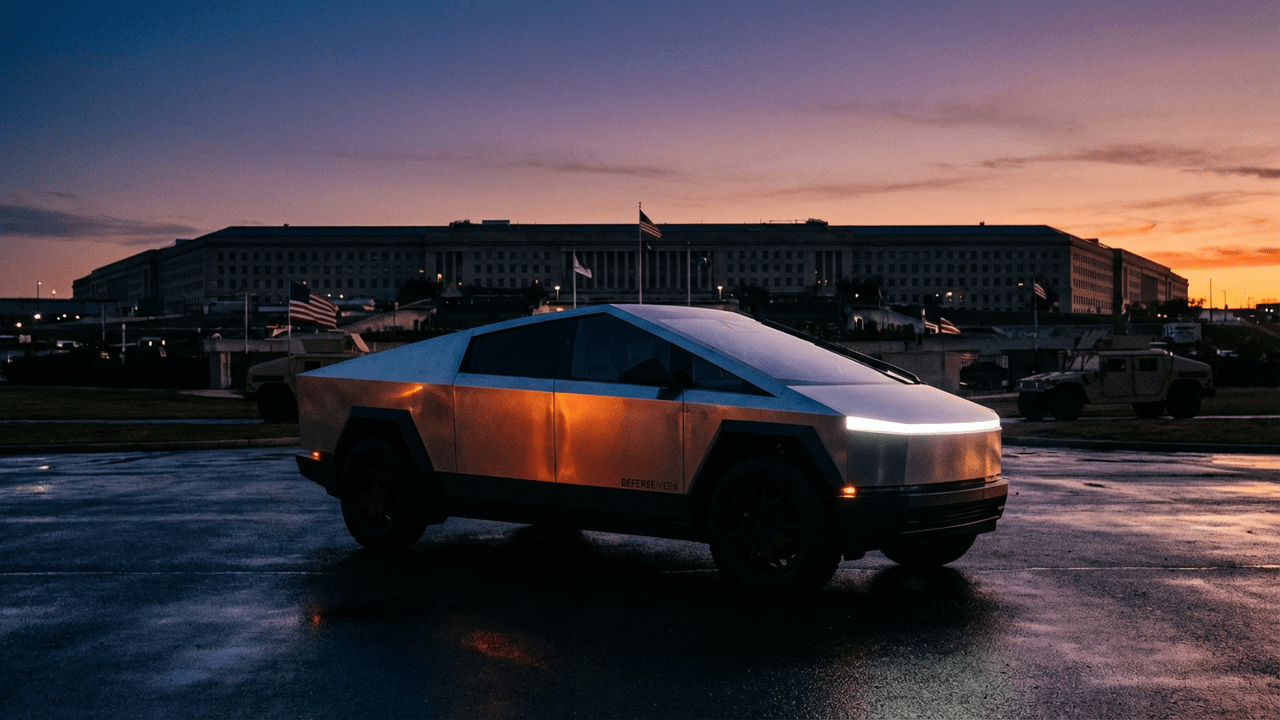
There was a time when the Pentagon and Silicon Valley lived in very different worlds.
One spoke in acronyms, security clearances, and defense budgets measured in hundreds of billions. The other talked about disruption, moonshots, and shipping fast. If you’d asked someone twenty years ago whether a futuristic electric pickup like the Tesla Cybertruck would ever be mentioned in the same breath as the Pentagon and big tech, they would’ve laughed.
Today, that laughter is gone.
Because the lines are blurring. Fast.
The conversation around Pentagon big tech Tesla Cybertruck isn’t about a single contract or one viral headline. It’s about a deeper shift in how modern power works. Military strategy is changing. Technology is moving faster than government systems were ever designed to handle. And unconventional companies the kind that build stainless-steel electric trucks that look like props from a sci-fi movie are suddenly part of serious defense conversations.
This isn’t hype. It’s reality unfolding in real time.
Let’s unpack how we got here, why it matters, and why the Cybertruck yes, that Cybertruck keeps popping up in discussions that used to be reserved for tanks, Humvees, and classified defense programs.
When the Pentagon Realized It Couldn’t Innovate Alone
The Pentagon is massive. That’s both its strength and its weakness.
With a budget that regularly tops $800 billion, the U.S. Department of Defense can build almost anything. Aircraft carriers. Stealth bombers. Hypersonic missiles. But there’s a problem that insiders have quietly admitted for years: traditional defense contractors move slowly.
Really slowly.
Long procurement cycles, layers of bureaucracy, risk aversion all of it made sense in a Cold War world where technology evolved over decades. But modern warfare doesn’t wait 20 years for a new platform. It evolves every 20 months. Sometimes faster.
That’s where big tech entered the picture.
Around the early 2010s, Pentagon leaders began openly acknowledging that the innovation edge had shifted. Artificial intelligence, cloud computing, autonomous systems, advanced sensors these weren’t being led by defense firms anymore. They were being built in Silicon Valley.
Google. Amazon. Microsoft. Palantir. SpaceX. Tesla.
Not all of them wanted military ties. Google famously faced internal protests over Project Maven, an AI initiative for analyzing drone footage. Employees didn’t want their code tied to warfare. But even when individual companies hesitated, the direction was clear.
The Pentagon needed big tech. And big tech, whether it liked it or not, was already shaping modern conflict.
Big Tech’s Quiet March Into Defense
This isn’t about tanks rolling out of Apple Park or Meta building fighter jets.
It’s subtler than that.
Big tech’s real value to the Pentagon lies in software, data, and infrastructure. Cloud services that can handle classified workloads. AI systems that can analyze battlefield data in seconds. Autonomous navigation. Satellite communications. Cybersecurity.
Amazon Web Services won a massive cloud deal (after years of legal drama). Microsoft secured defense cloud contracts. Palantir became deeply embedded in military data analysis. And SpaceX, through Starlink, reshaped battlefield communications in ways few predicted.
Ukraine made that reality impossible to ignore.
Starlink terminals became critical for maintaining communications under attack. Suddenly, a private company led by a famously unpredictable CEO had influence over a modern war zone. That was a wake-up call.
If satellites and software mattered this much, what about vehicles? Logistics? Mobility?
That’s where the Tesla Cybertruck starts to enter the conversation.
The Tesla Cybertruck Isn’t a Joke to the Military
At first glance, the Cybertruck feels like a meme on wheels.
Angular. Stainless steel. Bullet-resistant glass that famously broke during a demo. It doesn’t look like anything else on the road. And for months, people dismissed it as a vanity project.
But defense planners look at vehicles differently.
They ask uncomfortable questions.
- How durable is it?
- How easy is it to maintain?
- How does it perform off-road?
- Can it be modified?
- Can it operate quietly?
- What happens if fuel supply chains are disrupted?
An electric vehicle with a hardened exoskeleton suddenly doesn’t seem so ridiculous.
The Pentagon big tech Tesla Cybertruck discussion isn’t about replacing tanks with pickup trucks. It’s about niche roles. Recon. Base transport. Border patrol. Special operations logistics. Disaster response. Secure facility movement.
Electric vehicles have some advantages that matter in military contexts:
- Lower thermal signature.
- Near-silent operation.
- Fewer mechanical parts.
- Ability to generate onboard power.
- Reduced dependency on fuel convoys.
The Tesla Cybertruck’s stainless steel exoskeleton and design, extreme torque, and modular design make it interesting . Not perfect. Not battle-ready. But interesting enough that defense analysts are paying attention.
And that alone is significant.
Why Tesla’s Approach Feels Different From Traditional Contractors
Tesla doesn’t behave like Lockheed Martin or Raytheon.
It iterates fast. Breaks things publicly. Updates software over the air. Ships hardware that improves after purchase. That mindset aligns more with modern tech warfare than legacy defense procurement.
Think about how Tesla vehicles evolve. New driving features. Improved battery management. Security updates. All without visiting a dealership.
Now imagine a military vehicle that improves itself through software updates.
That idea excites some Pentagon innovators. Terrifies others.
The fear is control. Security. Oversight. What happens when a commercial company controls critical software? What if updates introduce vulnerabilities? What if geopolitics change?
These questions don’t have easy answers. But they don’t stop the conversation.
Big Tech, Defense Ethics, and the Employee Backlash Problem
There’s another layer here that often gets overlooked: people.
Big tech companies don’t just build technology. They employ hundreds of thousands of highly skilled engineers. And many of them are uncomfortable with military applications.
We’ve seen this play out repeatedly. Google employees protested AI contracts. Amazon workers questioned surveillance tools. Microsoft faced pressure over military partnerships.
Tesla is different, though.
Its culture isn’t driven by internal activism in the same way. It’s more centralized. More founder-driven. That makes defense collaboration structurally easier but not without controversy.
As the Pentagon big tech Tesla Cybertruck narrative grows, so will scrutiny. Not just from journalists, but from employees, investors, and the public.
Because once consumer technology becomes entangled with defense, the ethical questions follow fast.
The Cybertruck as a Symbol, Not Just a Vehicle
Even if the Cybertruck never becomes a standard military vehicle, it already plays a symbolic role.
It represents a shift in mindset.
The Pentagon is no longer only looking to traditional defense suppliers. It’s scanning the commercial tech landscape for ideas that can be adapted quickly. That includes electric vehicles, autonomous driving systems, advanced materials, and manufacturing techniques borrowed from Silicon Valley.
The Cybertruck embodies that crossover.
It’s unconventional. Polarizing. Technically ambitious. Designed outside military doctrine. And that’s exactly why it gets attention.
Sometimes innovation comes from places that don’t look “serious” at first.
How Other Countries Are Watching Closely
This isn’t just a U.S. story.
China, Russia, and other major powers are closely watching how the Pentagon works with big tech. They’re building their own equivalents. Civil-military fusion is a core strategy in China, where commercial tech companies are explicitly integrated into defense planning.
Electric vehicles, autonomous drones, AI-driven logistics these are global trends. Whoever integrates them fastest gains an advantage.
When the U.S. Pentagon explores partnerships involving big tech and experimental vehicles like the Tesla Cybertruck, it sends a signal. Innovation is no longer siloed. Commercial success and military relevance are increasingly linked.
What This Means for the Future of Warfare
Future conflicts won’t look like the past.
They’ll be faster. More data-driven. Less dependent on traditional hardware dominance. Software, logistics, and adaptability will matter as much as firepower.
Big tech understands speed. Iteration. Scalability.
The Pentagon understands strategy. Security. Force projection.
Where they overlap, new capabilities emerge.
The Pentagon big tech Tesla Cybertruck discussion is really about that overlap. About experimentation. About questioning old assumptions.
Will the Cybertruck itself change warfare? Probably not directly.
But the mindset it represents might.
FAQs: Pentagon, Big Tech, and Tesla Cybertruck
Is the Pentagon actually using Tesla Cybertrucks?
As of now, there’s no public confirmation of widespread military adoption. Most discussion centers around analysis, experimentation, and niche potential rather than official deployment.
Why would the military consider electric vehicles at all?
Electric vehicles offer quiet operation, lower heat signatures, fewer mechanical failures, and reduced reliance on fuel logistics, which can be critical in certain missions.
Is Tesla officially a defense contractor?
Tesla is not a traditional defense contractor, but like many big tech companies, its technology intersects with areas of interest to the Pentagon.
Why does big tech matter so much to modern defense?
Because modern warfare relies heavily on software, data, AI, satellites, and communication systems all areas where big tech leads innovation.
Is this trend controversial?
Yes. Ethical concerns, employee resistance, security risks, and civilian oversight are ongoing debates whenever commercial tech intersects with military use.
A World Where Steel, Software, and Strategy Intersect
The world is changing in quiet but profound ways.
A stainless-steel electric truck once mocked online is now part of serious defense conversations. Big tech companies once hesitant to engage with the military are now deeply embedded in national security infrastructure. And the Pentagon, long seen as slow and rigid, is actively searching for unconventional solutions.
The Pentagon big tech Tesla Cybertruck story isn’t about one vehicle or one company. It’s about a shift in how power, innovation, and defense connect in the 21st century.
Whether that future is safer, riskier, or simply different that’s still being written.
But one thing is clear.
The old boundaries are gone.
 seo provider